By Pilar Padilla
Director, Marketing & Communications
June 26, 2026
At Para Los Niños, our commitment to whole-child care means showing up for every child—exactly as they are. During Pride Month, we reaffirm that commitment by highlighting voices across our organization working to make children and families feel seen, safe, and supported. This month, we’re sharing three stories that show how solidarity can grow through storytelling.
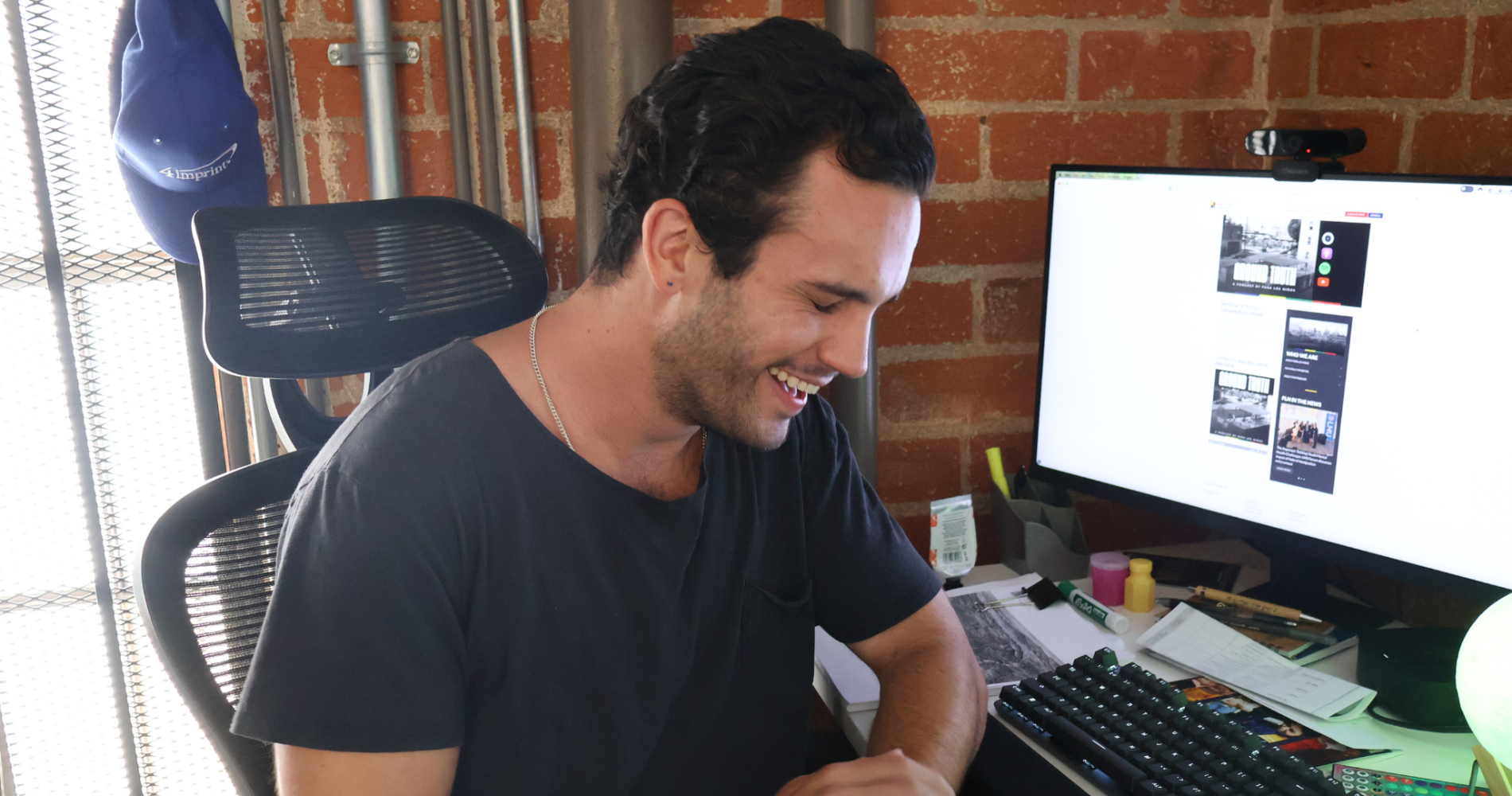
Nicholas Curl is the grandson of immigrants, a member of the LGBTQ+ community, and he’s Para Los Niños’ Communications and Digital Media Coordinator.
During his time here, he has supported storytelling in a number of different ways. In his role, he considers how to capture the stories of PLN staff, students and families as authentically as possible and determines what medium they should be shared in, from a joyous graduation video to long-form blogs going deeper into the innerworkings of our organization.
“Ultimately, we do everything we do because of stories – stories that we’ve heard or stories that we tell ourselves,” Nick says, “That’s how we make sense of our experiences and make decisions, looking for patterns in stories from the past. The power of communications is honestly, respectfully and effectively telling a story to get audiences to think about an issue in a new way they haven’t considered – to orient an audience around an issue in a way they haven’t considered before contradicts prior stories they’ve engrained.”
Nick’s story certainly influences the stories he tells here at PLN.
While he was born and raised in a well-to-do neighborhood in Eugene, Oregon, his grandmother was raised in severe poverty in the Azores, an autonomous chain of islands off the coast of Portugal. She was the youngest of 12 siblings whose mother and father had died by the time she was just 13. Married at 16, her husband passed away and his grandmother became a single mom to two young children as a relatively new immigrant in 1960’s northern California. She supported her family as a dishwasher while learning English by listening to the radio, and she eventually managed to work out an arrangement with a local school principal that allowed her to study and earn her high school diploma. Education was always a cornerstone of her values, and she held it up as the pinnacle of life experience.
“Two generations later, my sister is a doctor,” Nick shares proudly. “I see my grandma in a lot of the stories I hear – single moms fighting for their children and their children’s education. They know it’s one of the best ways to move up the socioeconomic ladder. Through her experience, I can see the big picture for families who are really struggling right now.”
Nick considers himself an incredibly lucky and privileged person and is dedicated to making sure that whatever small amount he’s able to contribute is a worthy use of his time and skills. When reflecting on how his background and identity intersects with his work, he shares: “Fundamentally, I believe that the struggles of all marginalized people are interconnected and intertwined, even if you don’t see it immediately. Being gay can be an invisible minority. Outside of being gay, I’m a cis-gendered white man from an upper middle-class family. I’m very grateful to be gay, because I think I’m a much more empathetic person because of it,” says Nick.